

Resources For Dancers
Below please find some helpful tools to use on your dance journey.
01
Cognitive Approach
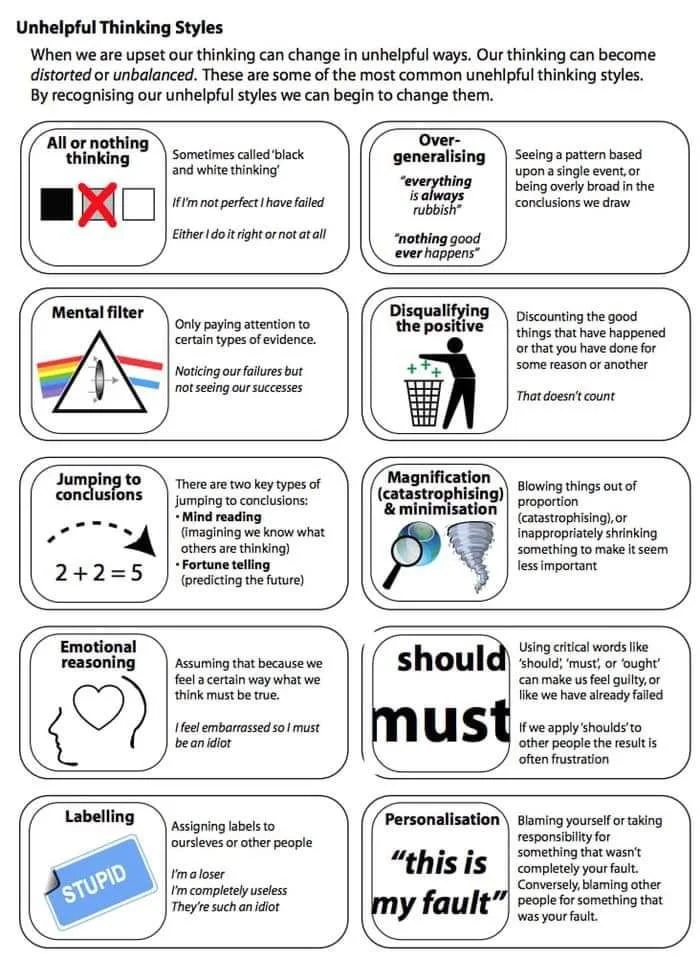
If you believe in the content of your anxiety, you may benefit from challenging the logic that you’re using.
If your body generally responds well to attempts to calm down, you may benefit from controlled breathing.
02
Behavioral Approach
Instructions:
To practice, place one hand on the belly and the other on your chest. (This is just to help with proprioception, and isn’t a necessary step while implement this skill in a real life scenario.)
When breathing, you should be able to feel the vast majority of movement coming from the belly.
Take a slow breath into the belly, lasting 4-5 seconds.
Breath out through the mouth for about 5-6 seconds. Your breath should be gentle enough that it there was a candle in front of your lips, the flame would flicker, not extinguish.
Repeat, not just a few times to “calm down”, but as a habit throughout your dancing.
If you experience heightened distress as a result of trying to calm down, you may benefit from an acceptance-based skill.
03
Mindfulness Approach
Instructions:
To practice, close your eyes or gently lower your gaze, so as to be able to focus on your body.
Identify where in your body you experience the distress.
Begin to observe this distress, as though you were an interested scientist taking notes. Gently, nonjudgmentally note the qualities of the distress:
How much of the body is it taking up?
What is the shape of the area it occupies?
Are those boundaries clear cut, or does the distress fade gradually into the unnafected parts of your body?
How much of your body is unnafected by the distress?
Does the physical anxiety change shape or size, or is it constant?
Breathe around the area of discomfort- not with the attitude of trying to get rid of it, but rather with an intention of creating space for the discomfort. Gently allowing it to be, giving full permission for it to exist.
When dancing, dance with this area of distress. On its own it is almost certainly a benign amount of distress. It is your struggle with it that amplifies it into something impactful. Be gentle, compassionate, and accepting to this area of discomfort, rather than trying to get rid of it.